The Case File

Sources & Records

A source-linked archive of the civil complaint, court records, police-interview reporting, institutional responses, disciplinary history, current developments and relevant context concerning the alleged 2024 incident. Browse by topic, search the full archive, or sort the case file by source number and date.

Featured Opinion · October 15, 2026

The New Yorker Found Time to Rehabilitate Chi Phi's Image. Jane Doe Deserved Better.

Ruby Cramer's sympathetic portrayal of former fraternity members, Adam Ford's aggressive legal tactics, and the extraordinary failure to scrutinize the original viral list deserve a public reckoning.

Share this op-ed Email Facebook X Reddit

A young woman alleges that she was drugged, sexually assaulted, and humiliated inside Cornell University's Chi Phi fraternity house. Her case has resulted in university disciplinary findings, expulsions, a civil lawsuit, and national outrage. She has since endured death threats, intimidation, and a terrifying swatting incident involving her family. Yet somehow, amid this unfolding nightmare, The New Yorker found considerable room for two former fraternity members to tell readers how progressive, inclusive, and protective of women their fraternity supposedly was.

I find that editorial decision absolutely appalling.

Ruby Cramer's October 14 article, The Doxing of Jane Doe, documents the survivor's suffering in disturbing detail. But it also offers former Chi Phi members identified as B. and T. an extraordinary opportunity to rehabilitate the image of a fraternity now associated with some of the most horrifying sexual assault allegations to emerge from an American university in recent memory.

One describes himself as progressive and an ally. Readers hear about Chi Phi's supposed commitment to diversity, its reputation among women, and members who allegedly intervened when others behaved inappropriately. Another describes a fraternity culture supposedly cautious about sexual harassment.

What a remarkable public-relations opportunity. Former members of a fraternity at the center of a national scandal get to reminisce about how wonderful and respectful their organization once was, while Jane Doe's allegations describe a fraternity environment in which a woman's presence was advertised to brothers using vile, sexually degrading language.

These men may sincerely believe their accounts. Their graduation dates are relevant to determining whether they belonged to the specific 2024 Snapchat group. But their nostalgic descriptions of Chi Phi are not an independent assessment of its culture, and they certainly do not erase what Jane Doe alleges happened after they left.

I expected more from Ruby Cramer. As a woman writing for a publication that has long positioned itself as a champion of progressive values, I expected her to use her platform to challenge the fraternity culture and institutional failures surrounding Jane Doe's allegations, not devote such extraordinary attention to helping former fraternity brothers rehabilitate the image of Chi Phi. Women who come forward with allegations of sexual violence already face extraordinary obstacles to being heard, believed, and protected. Watching a female journalist at one of America's most prestigious publications give these men such a sympathetic platform while Jane Doe continues to endure threats and intimidation is, in my opinion, a profound disappointment and a staggering failure of editorial judgment. I expected more from Cramer in defending the dignity of women confronting sexual violence, not in giving fraternity brothers an opportunity to defend the reputation of the very institution at the center of this nightmare.

This is particularly outrageous against the backdrop of what is happening across American campuses. Just this week, another woman reported a sexual assault at a fraternity house near the University of Chicago. At Colorado State University, a former student has filed a lawsuit alleging rape by a former fraternity member and negligence involving Phi Delta Theta. These are separate cases with distinct facts, but together they demonstrate why the scrutiny of fraternity culture is urgently necessary. Women are coming forward with serious allegations, and institutions are being forced to confront longstanding questions about safety, accountability, and the protection of students.

Meanwhile, I apparently warrant significant attention because I made a sarcastic Threads joke about burning a cease-and-desist letter.

Here's some context Cramer's article never adequately explores: When CornellSeven launched, I had approximately 22 followers on Threads. During that same first week, the disputed list of alleged Chi Phi Snapchat members was already viral across social media. Based on the activity I tracked, posts circulating that information had attracted nearly one million combined shares and interactions before my account developed any meaningful following. Cramer's own reporting describes a single TikTok that eventually approached two million views.

The list was already everywhere. Large accounts were circulating it, including personalities with audiences numbering in the millions. Its distribution was not initiated by me, its original audience was not created by me, and I did not publish the original circulating list on Threads or X.

Even more astonishingly, the article acknowledges that the original list remains online and continues accumulating views. Yet Cramer never meaningfully investigates social media posts that publicly credited self-described investigative journalist Troy Raymond Barile-Simleness with compiling the list. Whether that attribution was accurate warranted investigation, not silence. How does a national magazine examine the consequences of a viral list without establishing who compiled it, who first distributed it, and how its earliest amplification occurred?

Instead, readers receive an account of my website, a former description labeling information as verified, and my sarcastic cease-and-desist comment. Cramer characterizes my repeated explanation that I did not originate the list as though emphasizing that distinction were somehow suspect. I emphasized it because it is demonstrably central to the chronology. A journalist should not make a subject sound evasive for insisting on a distinction that the journalist's own reporting supports.

Then there is attorney Adam Ford, whose approach to CornellSeven has involved legal threats and accusations I regard as unnecessarily aggressive and unsupported by the evidence presented to me. Ford contacted me demanding that individuals be removed, and I complied. I did not drag his clients through litigation or wage a campaign against them. Yet the resulting narrative gives his representations considerable authority without showing readers independently authenticated Snapchat membership records establishing every claim made on his clients' behalf.

Ford appears remarkably eager to treat graduation dates as conclusive answers to questions that require considerably more evidence. But graduating from Cornell does not necessarily mean someone's involvement with Chi Phi ends. Consider Robert Shuck, whose extraordinary history with the fraternity was documented by GQ and the Cornell Daily Sun. Shuck spent years living inside the fraternity house, later served as a chapter adviser, and subsequently held leadership within its Chapter House Association. His history demonstrates that fraternity relationships can extend well beyond ordinary undergraduate enrollment. None of that establishes that Shuck—or any particular graduate—belonged to the October 2024 Snapchat group. But it does expose the weakness in treating graduation as definitive proof of nonmembership. A diploma is not a Snapchat membership record, and an attorney's cease-and-desist letter is not a substitute for one. If Ford possesses independently verifiable evidence establishing his clients' absence from that specific group, that evidence deserves consideration. What I will not accept is the expectation that his representations must be treated as established fact simply because he threatens legal action.

I am also deeply troubled by the apparent imbalance in investigative priorities. I have seen no publicly documented accounting of efforts by Ford to trace the original compilation and viral distribution of the list. That does not establish that no such efforts occurred. But it leaves a glaring question about why so much legal attention has been directed toward a later publisher when the original distribution remains unresolved and the list itself reportedly continues to circulate.

There is something profoundly disturbing about watching this controversy become a battle over fraternity reputations while the survivor's own account threatens to recede into the background. Jane Doe says she was treated as though her body existed for the entertainment of fraternity members. Cornell's disciplinary process resulted in expulsions. She has reportedly been threatened and terrorized for coming forward. No amount of sympathetic recollection about Chi Phi's supposed progressive values should soften the seriousness of those facts and allegations.

I founded CornellSeven because those allegations disgusted me. As a father, I could not imagine my daughter enduring what Jane Doe describes and then facing further intimidation for seeking accountability. My website was created to scrutinize the allegations, the available evidence, and Cornell University's institutional response—not to invent a viral list that already existed or orchestrate harassment I neither encouraged nor directed.

I will correct information when warranted. I will not apologize for scrutinizing publicly available fraternity records or demanding accountability from powerful institutions. And I certainly will not allow an attorney's aggressive correspondence or a magazine's selective editorial emphasis to rewrite the chronology of how this controversy began.

The New Yorker had the resources to examine the original list's circulation, its enormous audience, and the public leads concerning its compilation. Instead, it devoted substantial space to two men's descriptions of their former fraternity, their reputational distress, and my conduct as a website publisher. Cramer had every right to tell their stories. I have every right to regard the editorial balance as deeply misguided.

Jane Doe deserved more than to have the national conversation diverted toward polishing a fraternity's reputation and scrutinizing the sarcasm of a publisher who started with 22 followers.

The original viral list deserves investigation. Ford's factual representations deserve the same scrutiny he demands of others. And The New Yorker's editorial judgment deserves to be challenged publicly, especially when its reporting supplies the very chronology that undermines the impression created by its emphasis.

Because the real scandal has never been my Threads following, a cease-and-desist joke, or the discomfort of powerful institutions facing public scrutiny.

It is what Jane Doe alleges happened inside Chi Phi, what Cornell did in response, and what she has been forced to endure since seeking justice.

That is the story I refuse to let anyone bury.
Aaron B. FaulkFounder, CornellSeven.com
Quick reaction

Latest Additions

November 2, 2026

Eight additional source records researched through November 2 at 12:07 p.m. Pacific. Select a card to open the full record below.

Direct links to case updates and sections

Case sections

Individual source records

Loading records…

Source-language note: this archive distinguishes allegations from established findings. When conduct has not been established by a court, law-enforcement disposition or other adjudicative finding, the page uses terms such as alleged, reported or explicit attribution to the complaint, Jane Doe, an attorney, Cornell, law enforcement or the reporting outlet.
Loading case-file records…

Searchable Archive

All Case File Records

Select any record to read its full summary, source links, excerpts and notes.

Independent Public Record

Cornell's Own Records

Cornell's public records document the reported assault, the university's response and the institutional history of the Chi Phi Xi chapter before Jane Doe filed the September 2026 civil lawsuit.

Current Case Developments

Recent Developments

As of November 2 at 12:07 p.m. Pacific, the Attorney General's criminal investigation and Jane Doe's civil lawsuit remain pending. New reporting includes Assemblymember Anna Kelles's questions about Cornell Police interviewing, an Associated Press examination of Cornell's handling of a returning disciplined student's housing, the Cornell AAUP's formal reform demands and a Netflix documentary. The Faculty Senate's no-confidence ballot runs through November 6; the Sally Yates institutional review continues. Full source-linked accounts and earlier developments remain available below.

Investigation & Accountability

What Happened After Jane Doe Reported?

Public statements from Cornell, prosecutors and local police now provide a clearer — and in some places disputed — picture of what happened after Jane Doe reported the alleged assault.

Institutional Context

Campus and Greek-Life Context

Cornell's own data and public records provide broader context about sexual assault on campus, the disproportionate prevalence reported by women affiliated with Greek life, and the university fraternity system's response after the 2024 Chi Phi report.

Contemporary Public Record

The First Public Report

The November 2024 Crime Alert provides a contemporaneous record of what Cornell told its community immediately after the alleged assault was reported to university police.

Survivor & Public Response

The Case Moves Into Public View

Jane Doe's lawsuit and public comments have also prompted responses from the Cornell community, the campus newspaper's editorial board and public officials. These entries are clearly identified as commentary or attributed public statements rather than findings of fact.

National Coverage

The Case Reaches a National Audience

After the civil lawsuit and reopening of the criminal investigation, national news organizations began reporting on Jane Doe's allegations, Cornell's disciplinary process and the district attorney's renewed review.

Accountability & Campus Response

Pressure Builds Beyond the Lawsuit

New reporting has widened the public record beyond the civil complaint. State and local officials have called for additional scrutiny of Cornell, a university club has addressed former members named in the case, and students and alumni have described concerns about the broader campus culture.

Defendant Statements & Current Status

Public Denials, Admissions of Presence and Current Enrollment

Attorneys for several defendants have issued public denials. Some of those statements also acknowledge Snapchat participation or presence in the room while disputing any sexual assault or drug use. Separate Cornell directory reporting shows that two defendants continued to be listed as current students in late September 2026.

Student & Alumni Voices

Concerns About the Culture Predate the Lawsuit

Recent interviews and contemporaneous campus reporting show that concerns about sexual violence and fraternity culture were being voiced at Cornell before the September 2026 lawsuit brought national attention to Jane Doe's case.

October 2 Evidence Update

New Records and Reporting

Reporting published through 3 p.m. Pacific on October 2 added new material from Cornell's internal investigation, a longer version of the fraternity Snapchat conversation, newly unsealed disciplinary records and additional public responses to the case.

Primary Documents

Civil Complaint, Court Records & Primary PDFs

Read the filed 101-page complaint, six service records, legal-claims map and an 18-document primary-source library with plain-English breakdowns.

CASE FILE

THE 2026 LAWSUIT

Read the original 101-page court filing, browse the service and mailing records filed in the same case, or use the guided view to jump directly to key allegations, Cornell's response, and the legal claims in the lawsuit.

Jane Doe v. Cornell University, Inc., et al.

Supreme Court of the State of New York, County of New York. The file contains the summons followed by the plaintiff's civil complaint. The complaint is dated September 14, 2026; the NYSCEF filing date is September 16, 2026.

Filed September 16, 2026
Length 101 Pages
Court New York Supreme Court
Document Summons & Complaint
Important: The summaries on this page describe allegations made by the plaintiff in a civil complaint. They are provided to make the filing easier to navigate and understand. Allegations in a complaint are not findings of fact by a court.

Court File · Index No. 161704/2026

Choose which set of court records to view.

Plain English

What This Lawsuit Is

Page 3

Pages 3–4 · Paragraphs 1–7

Guided Sections
Viewing page 3 of 101

Some mobile browsers do not display embedded PDFs consistently. If the document does not appear above, open the full case file directly.

Key Pieces of Information

Primary PDF Library

18 Documents, Explained in Plain English

These are the filed court documents, Cornell policy records, institutional reports and public records now preserved in the Cornell Seven evidence folder. Each entry explains what the PDF actually is, what it says in ordinary language and why it matters to the larger record.

Jane Doe Civil Case & Criminal-Case Record

The filed civil complaint, Jane Doe's anonymity request and the district attorney's September 2026 public statement.

Jane Doe v. Cornell University — Filed Civil Complaint101 pages · NYSCEF Doc. 1 · Dated Sept. 14, 2026 · Filed Sept. 16, 2026

In plain English

This is the court-filed version of Jane Doe's 101-page lawsuit. It lays out her account of the October 2024 night at Chi Phi, identifies the individual and institutional defendants, describes the Snapchat messages and post-incident events, and pleads the civil causes of action she is asking a New York court to resolve.

The complaint is a set of allegations, not a judgment. It is nevertheless the foundational primary document for the public case because it is where Jane Doe formally put her account, the identities of the defendants and her legal claims into the court record.

Why it matters: Nearly every later news report, institutional response and renewed criminal-investigation development traces back to allegations and evidence described in this filing. The guided complaint viewer above now uses this court-stamped copy.
Jane Doe — Attorney Affirmation Supporting Request to Proceed Anonymously8 pages · NYSCEF Doc. 3 · Filed Sept. 16, 2026

In plain English

Attorney Thomas Giuffra asks the court to allow the plaintiff to litigate under the name Jane Doe and to prevent the defendants and their agents from publicly disclosing her identity except as necessary to their attorneys. The filing argues that sexual-assault privacy, safety, stigma and the risk of further harm justify pseudonymity.

The request is about protecting Jane Doe's identity; it does not ask the court to hide the entire lawsuit or the factual allegations from the public.

Why it matters: The filing documents that survivor privacy was an explicit court issue from the beginning of the civil case — long before later online attempts to identify her and the threats reported in October.
Tompkins County District Attorney — Statement Regarding Jane Doe v. Cornell9 pages · Public statement · Sept. 28, 2026

In plain English

District Attorney Matthew Van Houten explains why his office did not bring charges in 2024 and announces that the case is being reopened after the civil lawsuit. His statement says prosecutors relied on Jane Doe's six-page sworn statement and believed the facts described there did not establish a prosecutable crime under the law as they understood it.

Later reporting materially complicated that explanation: Van Houten said he had not seen Jane Doe's roughly 120-page police-interview transcript containing her explicit statement that she had been raped, and records later showed the DA's office did not ask to review additional CUPD interview material before the original case was closed.

Why it matters: This is the DA's own detailed account of the original non-prosecution decision. It should be read alongside the later evidence-transfer reporting rather than treated as the final description of what CUPD had collected.

Scott Kretzschmar Article 78 Court Record

The petition challenging Cornell's disciplinary process, Cornell's response, the underlying hearing materials and the court's dismissal.

Scott Kretzschmar / “John Doe” — Article 78 Petition Against Cornell17 pages · Tompkins County NYSCEF Doc. 1 · Filed Mar. 30, 2026

In plain English

Kretzschmar challenged Cornell's disciplinary decision in state court. His petition says Cornell charged him with sexual assault and sexual exploitation, ultimately found him not responsible for those charged offenses, but found him responsible for attempted sexual exploitation based on conduct that he argued had not been separately charged.

He also attacked the hearing process, including the fact that panelist Savannah Bao was in a vehicle for approximately 45 minutes during the multi-day hearing. The petition sought to annul the finding and sanctions and to expunge the disciplinary result.

Why it matters: The petition is the defense-side document that caused portions of Cornell's otherwise private disciplinary record to enter a public court case. It also identifies the sanctions Kretzschmar was challenging.
Cornell — Memorandum in Opposition to Kretzschmar's Petition30 pages · Article 78 court filing · 2026

In plain English

Cornell argues that Kretzschmar received adequate notice and a fair process. The University says Policy 6.4 expressly allowed a hearing panel to hold a respondent responsible for other policy violations revealed by the evidence, even if the final label differed from the originally charged offense.

The brief defends the attempted-sexual-exploitation finding and the hearing process and discusses evidence from the underlying investigation, including the Snapchat record. It is Cornell's legal explanation for why the disciplinary result should survive judicial review.

Why it matters: This filing puts Cornell's own defense of its disciplinary machinery into a public court record and preserves portions of the evidence and procedural history that would otherwise be difficult to see.
Decision and Order Dismissing Kretzschmar's Article 78 Petition10 pages · NYSCEF Doc. 37 · Filed Sept. 23, 2026 · Justice Mark G. Masler

In plain English

The court rejected Kretzschmar's attempt to overturn Cornell's decision. Justice Mark G. Masler concluded that the attempted-sexual-exploitation finding was not arbitrary or capricious and that Cornell's formal complaint had warned that other violations revealed during the process could result in responsibility.

On the distracted-panelist argument, the court noted that the roughly 45 minutes in question represented a small portion of a 12-day hearing and a 1,732-page transcript. The court found no basis to treat the episode as a procedural defect serious enough to invalidate the result.

Why it matters: This is not merely Cornell defending itself — it is the state court's ruling upholding Cornell's Kretzschmar-specific disciplinary decision against the challenges raised in his petition.
Cornell Hearing Panel Decision & Report — Kretzschmar Record99 pages · Submitted Aug. 18, 2025 · Publicly filed Sept. 30, 2026

In plain English

This heavily redacted 99-page report is the most detailed primary document now public from Cornell's internal hearing process. For Kretzschmar, the panel found him not responsible for sexual assault but responsible for attempted sexual exploitation.

The panel's reasoning focused on his conduct after the Snapchat message advertising “free” sexual access and the confirmation that a woman was in the alumni room. The panel concluded that he entered intending to observe a person who was nude or engaged in sexual activity without her consent. The report also discusses disputed ketamine evidence, conflicting witness accounts and the broader hearing record.

The sanctions described include a one-way no-contact order, a directed study addressing social media, sexual harassment and bystander intervention, and a reflection paper with recommendations; the decision specified that generative AI could not be used for that assignment.

Why it matters: This is a direct window into Cornell's evidentiary analysis rather than a press summary. It shows what one panel actually found, what it did not find and how it explained the distinction.
Affirmation of Lauren Branchini — Hearing Record Authentication & Procedural Roadmap13 pages · NYSCEF Doc. 47 · Filed Sept. 30, 2026

In plain English

Lauren Branchini, who served as Cornell's Title IX coordinator and hearing chair, authenticates the record Cornell submitted for judicial review and walks the court through the disciplinary process. Her filing describes the original formal complaint involving seven respondents, the investigation, the draft record, the 12-day May 2025 hearing, the hearing transcripts and the later appeal.

Branchini identifies the hearing record as thousands of pages and explains where the hearing transcripts and decisions sit within that record. She also addresses the period when panelist Savannah Bao was driving and states that the three-member appeal panel unanimously affirmed the decision and sanctions on January 14, 2026.

Why it matters: This is one of the clearest primary-source roadmaps to how Cornell's internal case moved from formal complaint to investigation, hearing, decision and appeal.
Notice of Student Conduct Charges / Formal Complaint6 pages · Distributed Jan. 16, 2025 · Filed as NYSCEF Doc. 4

In plain English

This is Cornell's formal notice opening the Policy 6.4 case. It says the matter would proceed under the procedures effective August 5, 2024 and describes alleged sexual-assault and sexual-exploitation conduct involving multiple undergraduate respondents.

In the visible Kretzschmar-specific portion, Cornell alleged that he intentionally viewed the complainant while she was undressed without permission and made physical contact with her naked body while inhaling a powdered substance without affirmative consent. The notice also expressly warned that respondents could be held responsible for policy violations not specifically listed in the original complaint if those violations emerged from evidence, testimony or admissions during the process.

Why it matters: That final notice provision became central to Kretzschmar's later court challenge because Cornell ultimately found him responsible for attempted sexual exploitation rather than the exact charged label he argued he had been given.
Cornell Policy 6.4 Procedures — Court-Filed Exhibit46 pages · Article 78 exhibit · 2026 court record

In plain English

This is the Policy 6.4 procedural rulebook placed into the Kretzschmar court record. It defines prohibited conduct, affirmative consent, incapacity and attempted misconduct and sets out the investigation, notice, hearing, sanction and appeal process Cornell said governed the disciplinary case.

Because it was filed as an exhibit in the Article 78 litigation, it is the policy text the parties and court were using when they argued about notice, attempted sexual exploitation and the fairness of Cornell's process.

Why it matters: The document lets readers compare Cornell's written rules with both Jane Doe's allegations about how the University handled her case and Cornell's defense of its disciplinary process.
Cornell Letter Asking Court to Seal the Full Disciplinary Record1 page · NYSCEF Doc. 13 · Filed June 2, 2026

In plain English

Cornell's Office of General Counsel asked the court to permit the University's disciplinary record to be filed unredacted under seal because the underlying matter involved seven respondents, additional witnesses and highly sensitive information. The letter describes a massive record: twelve hearing days, thousands of pages, a 99-page hearing decision, more than 1,700 pages of hearing transcript and audio/visual evidence.

The filing says Kretzschmar's counsel consented to the request.

Why it matters: Even though most of that full record remains inaccessible, this one-page filing independently documents the scale of Cornell's internal proceeding and explains why the court initially protected so much of it from public access.
Hearing Emails About Panelist Savannah Bao's Distractions and Driving23 pages · NYSCEF Doc. 45 · Filed Sept. 30, 2026

In plain English

This PDF preserves the actual hearing communications behind one of Kretzschmar's procedural objections. His attorney Jeremy Saland complained that panelist Savannah Bao appeared to be working or doing other things during the remote hearing and later objected after she participated while driving for roughly 45 minutes.

The emails show the requests for intervention, adjournment or a new hearing and Cornell's responses as the proceeding continued.

Why it matters: The emails are the underlying primary record for the “distracted panelist” issue. They establish that the objection was made contemporaneously; they do not, by themselves, establish that the hearing was invalid. Cornell's appeal panel and the state court later rejected that argument.
Cornell Appeal Panel Decision — Kretzschmar2 pages · Final University action Jan. 14, 2026 · Filed Sept. 30, 2026

In plain English

A three-member Cornell appeal panel unanimously affirmed the hearing decision and sanctions. It called the period when a panelist was in a vehicle a substantially de minimis portion of a hearing spanning many hours and multiple days and said the hearing chair had addressed the problem promptly.

The appeal panel also rejected Kretzschmar's argument that he lacked notice of attempted sexual exploitation, pointing to the formal complaint's warning that additional violations could be identified during the process. It rejected allegations that the hearing chair or Title IX coordinator had schemed or acted with bias as unsupported by the record.

Why it matters: This was Cornell's final internal action before Kretzschmar went to court. It shows exactly which procedural arguments the University considered and rejected on appeal.
Amended Sealing / Unsealing Order in the Article 78 Case2 pages · NYSCEF Doc. 43 · Sept. 30, 2026

In plain English

This amended court order determines which parts of the Article 78 record remain sealed and which may be publicly available. It keeps a specified group of NYSCEF documents under seal while allowing other documents to be public, generally after confidential information was redacted and refiled.

The order preserves the sealed originals while making a meaningful subset of the litigation — including several of the PDFs in this library — available for public review.

Why it matters: This order is the reason readers can now inspect portions of Cornell's disciplinary record that were previously inaccessible while highly sensitive portions remain protected.

Cornell Policy, Governance & Campus Context

Official Cornell procedures, a Student Assembly resolution, the 2025 sexual-misconduct survey and the 2026 presidential task-force report.

Procedures for Resolution of Reports Against Students Under Policy 6.446 pages · Official Cornell procedures · Effective Aug. 5, 2024

In plain English

This is Cornell's official student procedure manual that took effect before the alleged October 2024 incident. It defines concepts including affirmative consent, incapacitation, sexual assault and sexual exploitation and lays out how reports are investigated, how respondents receive notice, how hearings work, possible sanctions and the appeal process.

Why it matters: It is the contemporaneous rulebook for evaluating what Cornell said it was supposed to do, separate from the dispute over what the University actually did in Jane Doe's case.
Cornell Student Assembly Resolution 172 pages · Presented Nov. 14, 2024

In plain English

The Student Assembly resolution places Cornell's November 2024 crime alert into the University's own governance record. It references a report that an undergraduate student was sexually assaulted and coerced into consuming ketamine and other drugs in the 100 block of Edgemoor Lane and calls for a community restorative day.

The resolution dates the incident it references to October 25, 2024, while Jane Doe's later civil complaint places the alleged Chi Phi assault on October 19 into October 20. CornellSeven.com has not located a public record explaining that date discrepancy.

Why it matters: It is an official contemporaneous Cornell document showing that a sexual-assault-and-drugging report on Edgemoor Lane was already part of the University's public record in November 2024.
2025 Survey of Sexual Assault and Related Misconduct — Cornell Report19 pages · Cornell University · Released Nov. 4, 2025

In plain English

Cornell's 2025 survey reported that 35% of undergraduate women respondents said they had experienced nonconsensual sexual contact during their Cornell careers, compared with 23% in 2023. Across all respondents, the figure was 15%, compared with 11% in 2023. The report also said 49% of respondents experienced sexual or gender-based harassment and that only 23% of respondents reporting nonconsensual sexual contact contacted a formal resource.

Cornell cautioned that participation was low: 926 students responded from a random sample of 6,000, an overall response rate of about 15%. The University said the low response rate makes population estimates less certain.

Why it matters: This is Cornell's own campus-climate data. It provides broader institutional context for why the response to Jane Doe's case has triggered concerns extending well beyond one fraternity or one disciplinary proceeding.
Presidential Task Force on Campus Sexual Assault — Final Report35 pages · Cornell University · March 2026

In plain English

Cornell's presidential task force reviewed campus sexual-assault data and recommended changes to prevention, education, culture and institutional response. Among the report's most striking survey findings, 52% of Greek-affiliated undergraduate women respondents reported sexual assault during their time at Cornell, compared with 29% of undergraduate women respondents who were not Greek-affiliated.

The report said fraternity chapter houses accounted for 17% of the locations identified for reported sexual assaults in the 2025 survey and recommended recurring in-person training on consent, sexual citizenship and bystander intervention for fraternity and sorority members and leaders. The task force also cautioned that the undergraduate survey response rate was only 13%, limiting the precision of prevalence estimates.

Why it matters: Cornell itself identified Greek-life risk and recommended stronger prevention measures months before Jane Doe's civil lawsuit made the Chi Phi case a national story.

Primary Source Images

Chi Phi Actives Snapchat Material

Open the complaint-reproduced Snapchat image and the separately documented “Michael” comparison material.

Additional Source

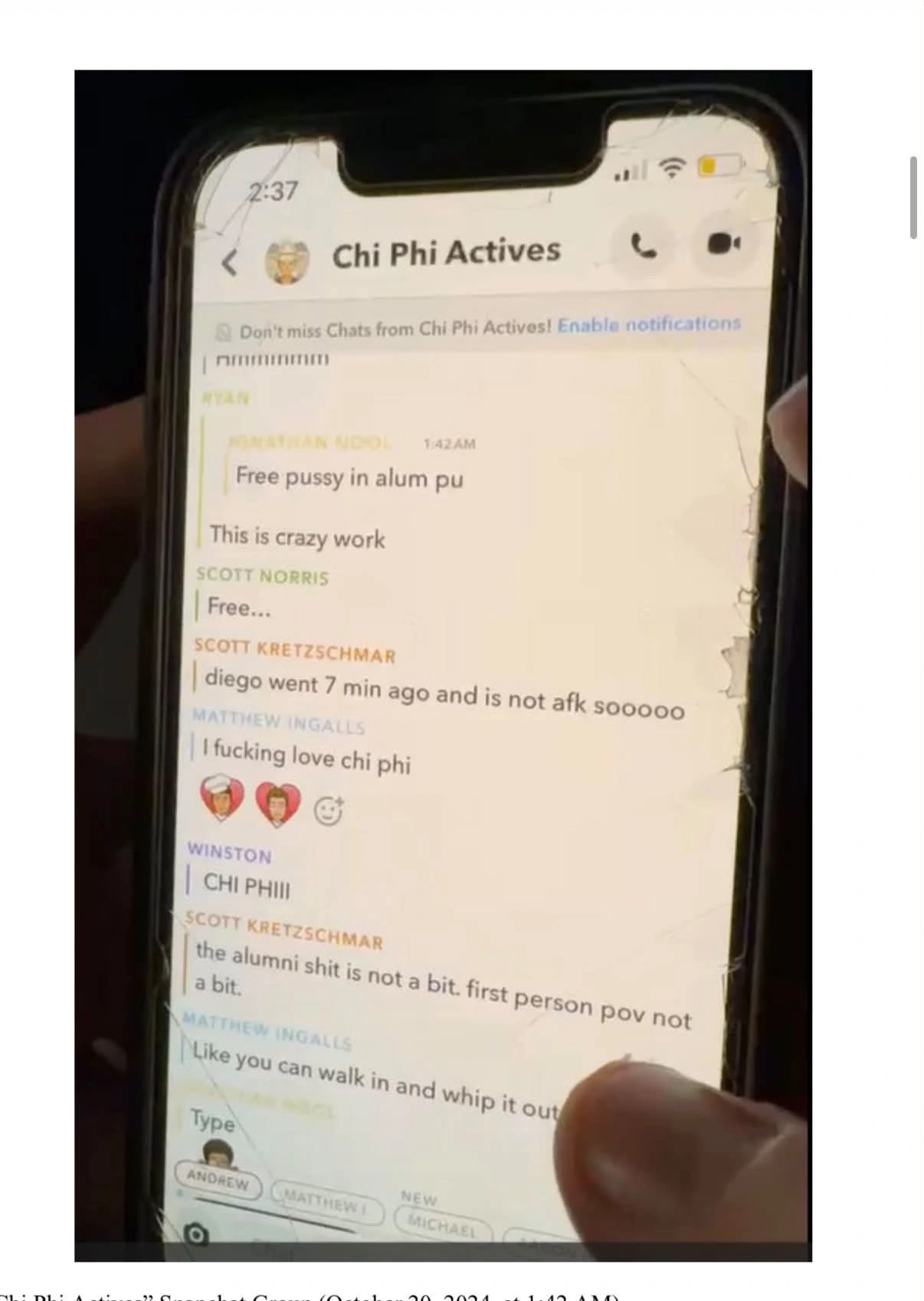
Chi Phi Actives Snapchat Image

This is a Snapchat conversation reproduced in the civil complaint and described there as occurring during the night of the alleged assault.

CornellSeven.com is presenting the image as source material and is not independently authenticating the accounts, identities, or messages shown beyond what is stated in the court filing.
Open Full Image
Photograph of a phone displaying a Snapchat group titled Chi Phi Actives

Additional Source

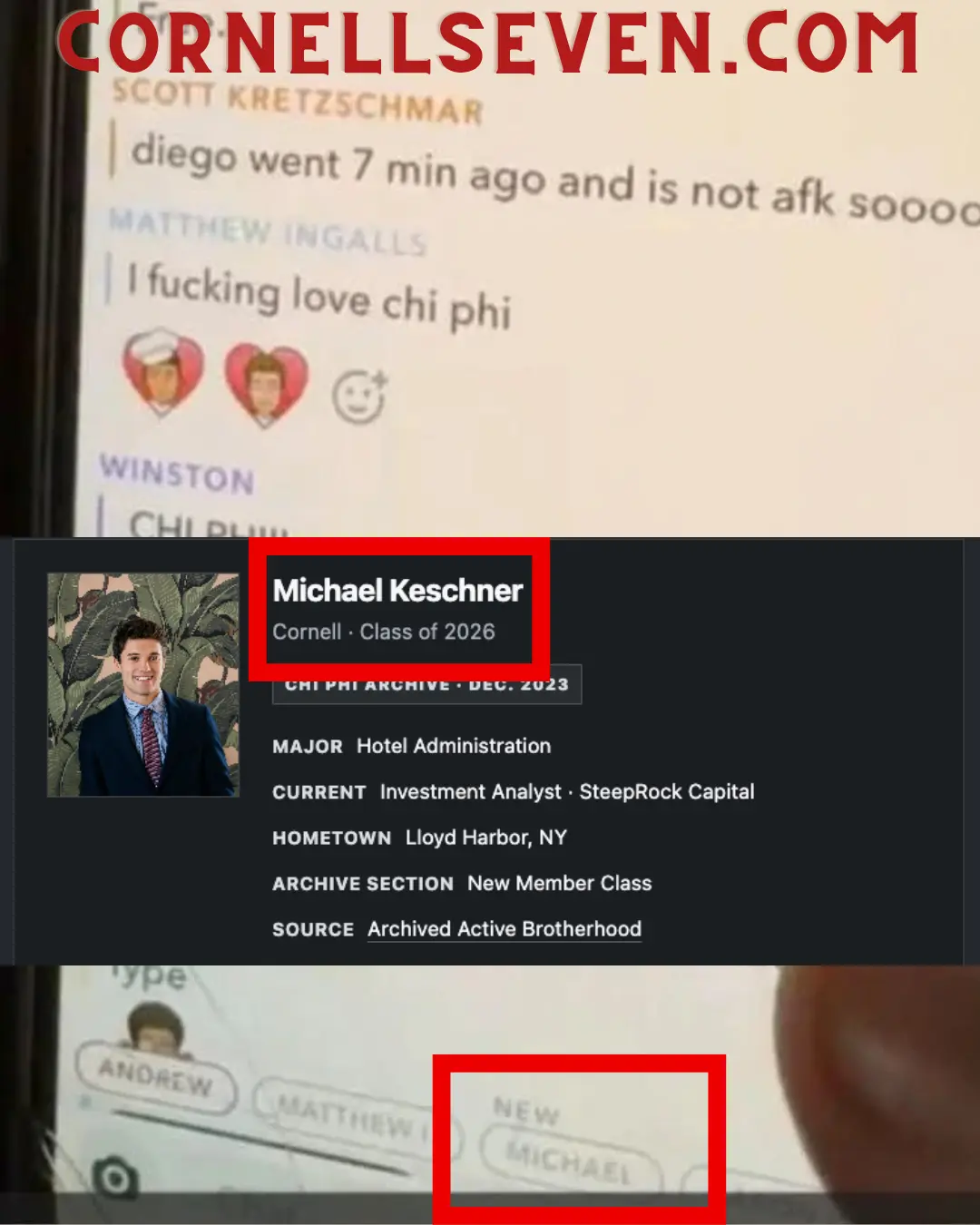
Chi Phi Actives Snapchat — “Michael”

A screenshot of the Chi Phi Actives Snapchat group shows a member identified as “MICHAEL.” CornellSeven.com’s review of archived Chi Phi active-brotherhood material identifies Michael Keschner, Cornell Class of 2026, as the Michael associated with the chapter in the material reviewed for the relevant period.

No other Michael has been identified in the archived active-brotherhood material reviewed by CornellSeven.com. The composite image below places the Snapchat member name beside the archived Chi Phi record so readers can examine the basis for that identification themselves.

Identification note: The Snapchat screenshot itself displays only the first name “MICHAEL.” The identification of that account as Michael Keschner is CornellSeven.com’s inference from the archived active-brotherhood material shown here, not an identification stated in the civil complaint.
Open Full Image
Composite source image showing the Chi Phi Actives Snapchat member name Michael and an archived Chi Phi profile for Michael Keschner

Historical Context

Op-Ed: Building Better Predatory Men

Long-form editorial and supporting source links on Chi Phi's documented history and institutional context.

OP-ED · HISTORICAL CONTEXT

BUILDING BETTER PREDATORY MEN

“Truth Dishonesty, Honor Contempt, and Personal Integrity Corruption.”

Share This Op-Ed Email Facebook X Reddit

The allegations surrounding Chi Phi should not be examined as if this fraternity never had issues. Public reporting dating back more than two decades raises serious concerns about the culture that Chi Phi’s own alumni leadership has tolerated and uplifted.

In 2005, GQ profiled Rob Shuck, then a 31-year-old Cornell undergraduate who had enrolled in 1993 and had spent over a decade living in the basement of the Chi Phi fraternity house. The profile portrayed Shuck’s extended undergraduate life as something of a campus legend. His annual birthday celebration had grown into a 150-person wine tour centered heavily around drinking. Shuck also openly discussed having dated an 18-year-old Cornell freshman the previous year, when he was 30. He acknowledged that their age difference eventually became an issue. It begs the question, how many other teenagers did this adult attempt to groom?

Two years later, the Cornell Daily Sun reported that Shuck was still taking classes and still living in Chi Phi’s basement at age 32, roughly thirteen years after first enrolling at Cornell. By then, his prolonged fraternity lifestyle had become so well known that he had been featured in GQ, appeared on The View, and become the subject of a short documentary titled 32 Yr. Old Frat Boy. Once again, this grown adult man’s behavior was being glorified. It was as if they didn’t want us to realize how incredibly creepy it was for him to be living in a house with teens and young, immature, vulnerable adults.

This history matters because Shuck did not simply fade away as an eccentric former fraternity member. In 2006, while he was still a longtime undergraduate, the Cornell Daily Sun identified him as Chi Phi’s chapter advisor. Years later, Cornell records identified him as president of the Chi Phi Chapter House Association. Today, Chi Phi’s own website lists him in that same leadership position. The Chapter House Association says it advises the active chapter, handles operational matters, represents undergraduate interests, and acts as the primary alumni interface between Chi Phi and Cornell.

That progression is what deserves persecution. A man who spent more than a decade embedded in an undergraduate fraternity environment and publicly discussed dating a freshman half a generation younger than himself should never be glorified. Shuck became nationally known for refusing to grow up and act his age. Chi Phi leadership should have forced him out. They never should have condoned this behavior. He never should have been placed in a position of authority over the chapter.

None of that proves that Shuck knew about or participated in the conduct alleged in the current lawsuit. It does, however, raise a legitimate broader question: What behaviors has Chi Phi historically considered as acceptable? What kinds of boundaries has its leadership chosen to normalize?

What else has this fraternity done that Chi Phi was able to sweep under the rug? My opinion is that this case is only the tip of the iceberg and we are soon going to unravel much more than we ever expected.

Chi Phi’s own national risk-management policy now states that the fraternity will not tolerate or condone sexually abusive behavior and requires members to respect the dignity of others. When an organization has to publicly adopt those standards, its past and present leadership are fair subjects for persecution. That is not only for what they prohibit on paper, but for the culture they have cultivated in practice.

Photograph published with GQ's 2005 profile of Rob Shuck
Photo: Nathaniel Welch / GQ, 2005. Published with “The Best Twelve Years of His Life.”
Email Rob Shuck
Quick Reaction