Additional Source

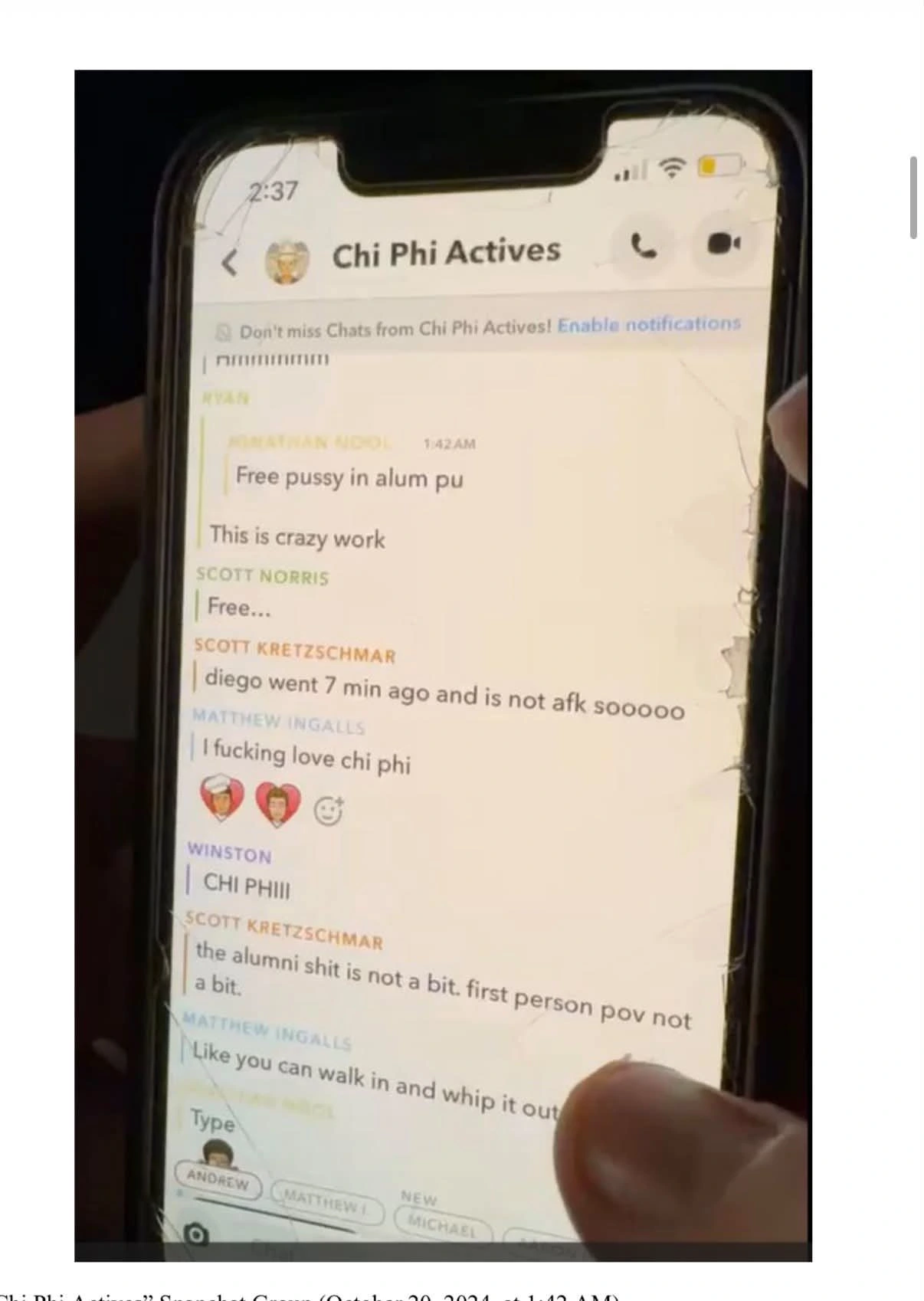
Chi Phi Actives Snapchat Image

This is a SnapChat conversation from the night of the rape.

CornellSeven.com is presenting the image as source material and is not independently authenticating the accounts, identities, or messages shown beyond what is stated in the court filing.
Open Full Image
Photograph of a phone displaying a Snapchat group titled Chi Phi Actives

CASE FILE

THE 2026 LAWSUIT

Read the original 101-page court filing or use the guided view to jump directly to the sections that explain the allegations, the people named, Cornell's response, and the legal claims in the lawsuit.

Jane Doe v. Cornell University, Inc., et al.

Supreme Court of the State of New York, County of New York. The file contains the summons followed by the plaintiff's civil complaint.

Filed September 14, 2026
Length 101 Pages
Court New York Supreme Court
Document Summons & Complaint
Important: The summaries on this page describe allegations made by the plaintiff in a civil complaint. They are provided to make the filing easier to navigate and understand. Allegations in a complaint are not findings of fact by a court.

Plain English

What This Lawsuit Is

Page 3

Pages 3–4 · Paragraphs 1–7

Guided Sections
Viewing page 3 of 101

Some mobile browsers do not display embedded PDFs consistently. If the document does not appear above, open the full case file directly.

Key Pieces of Information

Independent Public Record

Cornell's Own Records

Cornell's public records document the reported assault, the university's response and the institutional history of the Chi Phi Xi chapter before Jane Doe filed the September 2026 civil lawsuit.

Official Cornell Governance Record November 2024
01

Student Assembly Resolution 17

Cornell University Office of the Assemblies

Before the civil lawsuit was filed, Cornell's Student Assembly placed the reported assault into the university's own public record through Resolution 17.

The resolution refers directly to the Crime Alert sent to the Cornell community on November 8, 2024. It says the alert described a Cornell undergraduate who had been sexually assaulted and coerced into consuming ketamine and other drugs in the 100 block of Edgemoor Lane in Ithaca.

The resolution was adopted by the Student Assembly and its official Cornell page lists its status as acknowledged by the president.

From the Cornell record

“Sexually assaulted and coerced into consuming ketamine and other drugs.”

Record note: Resolution 17 dates the incident described in Cornell's Crime Alert to October 25, 2024. The September 2026 civil complaint places the alleged assault on the night of October 19 into the morning of October 20. CornellSeven.com has not located a public record explaining the difference between those dates.
Official Cornell Statement November 26, 2024
02

Cornell Publicly Addresses the Chi Phi Investigation

Office of the President · Cornell University

Less than three weeks after the November 8 Crime Alert, then- Interim President Michael Kotlikoff issued a university-wide statement addressing the reports from the Chi Phi house.

Cornell said that a number of students had been temporarily suspended and that Chi Phi remained temporarily suspended while the criminal investigation continued. The university also said its student-conduct and Title IX offices were reviewing the information that had been reported about events at the fraternity.

The statement documents Cornell's response at the time, nearly two years before Jane Doe filed the civil complaint now at the center of this site.

Cornell's words

“Only those who perpetrate sexual violence benefit from its concealment.”

Official Cornell Organization Record Current Cornell Record
03

Cornell's Chi Phi Organization Scorecard

Cornell Student & Campus Life

Cornell's official organization scorecard identifies Chi Phi's Xi chapter at 107 Edgemoor Lane and identifies the fraternity house as university-owned. The university currently lists the chapter's recognition status as Interim Suspension.

The same Cornell record preserves the chapter's earlier judicial history. In 2020, the chapter was found responsible for event management violations involving overcrowding and insufficient sober monitors. A separate 2018 proceeding involved findings related to hazing, hard liquor and providing alcohol to people under 21.

Cornell's scorecard also records a 2023 resolution involving prohibited conduct by the organization. These earlier matters are separate from the October 2024 allegations, but they are part of Cornell's own published history of the chapter.

Current Cornell Status

Recognition Status: Interim Suspension

Context: The earlier scorecard entries are not findings about Jane Doe's allegations. They are included here as Cornell's published institutional record for the Chi Phi Xi chapter.

Current Case Developments

Recent Developments

The criminal investigation has been reopened, Jane Doe has spoken publicly about the impact of the alleged assault and its aftermath, and Cornell has confirmed that its own investigation has concluded.

Prosecutor Statement · ABC News September 27, 2026
04

Criminal Investigation Reopened

Tompkins County District Attorney · ABC News

On September 27, 2026, Tompkins County District Attorney Matthew Van Houten confirmed that prosecutors had reopened their review of the alleged 2024 assault at Cornell's Chi Phi fraternity house.

Van Houten told ABC News that his office is again considering whether criminal charges should be brought and intends to present the case to a Tompkins County grand jury with Jane Doe's cooperation.

The renewed investigation is also examining evidence that prosecutors say was not previously available to their office. Van Houten acknowledged that his office relied on the investigation conducted by Cornell University Police in 2024 and did not independently investigate the allegations.

He also said the fraternity group-chat evidence reproduced in the civil complaint was never provided to his office during its earlier review.

Jane Doe's attorney, Thomas Giuffra, disputes that account. Giuffra says the group-chat evidence was provided to authorities in 2024 and has criticized the lack of follow-up with Jane Doe after she reported what happened.

From the District Attorney

“It's our intention to present the case to the Tompkins County grand jury with Jane Doe's cooperation.”

Current status: The investigation has been reopened and prosecutors are reconsidering whether criminal charges should be brought. The announced grand-jury presentation does not mean that an indictment or criminal charges have already been issued.
Jane Doe Statement · Cornell Daily Sun September 18, 2026
05

Jane Doe Speaks Publicly

The Cornell Daily Sun

Four days after filing her civil lawsuit, Jane Doe spoke publicly to The Cornell Daily Sun about the impact the alleged assault has continued to have on her life.

She described what happened to her as horrific and said that, nearly two years later, she continued to carry the impact of the experience every day and night.

Jane Doe's Words

“Almost two years later, I still carry the weight of its impact every day and night.”

Jane Doe also spoke about what happened after she reported the alleged assault. She said she was deeply disappointed by the lack of support she received from the student community and described being criticized and ostracized during a time when she needed compassion, support and care.

Her public comments add her own voice to a record that had previously been documented largely through the university, law enforcement and the allegations contained in her civil complaint.

Official Cornell Statement September 21, 2026
06

Cornell Confirms Its Investigation Has Concluded

Cornell University · Office of University Relations

On September 21, 2026, Cornell publicly confirmed that its investigation into the alleged 2024 incident at the Chi Phi house had concluded.

Vice President for University Relations Kyle Kimball said Cornell's Office of Civil Rights and Office of Student Conduct and Community Standards investigated and adjudicated the allegations under university policies.

Cornell also confirmed that the Xi chapter of Chi Phi continues to be barred from campus.

Cornell's Current Position

Chi Phi “remains barred from our campus.”

Cornell declined to disclose disciplinary consequences involving individual students. The university cited federal student-privacy law and said it is prohibited from publicly releasing specific information about individual disciplinary responses.

Cornell stated that violations of university policy can result in sanctions up to and including suspension or expulsion, but did not publicly identify what sanctions were imposed on any individual student connected to the investigation.

Record update: The September 2026 statement independently confirms that Cornell's university investigation is no longer pending. Cornell has not publicly disclosed the individual outcomes of that process.

Institutional Context

Campus and Greek-Life Context

Cornell's own data and public records provide broader context about sexual assault on campus, the disproportionate prevalence reported by women affiliated with Greek life, and the university fraternity system's response after the 2024 Chi Phi report.

Official Cornell Task Force Report March 2026
07

Cornell's Task Force Identifies Elevated Risk in Greek Life

Presidential Task Force on Campus Sexual Assault

In March 2026, Cornell's Presidential Task Force on Campus Sexual Assault issued its final report examining sexual assault among undergraduate students and recommending changes to prevention, education, campus culture and institutional response.

Among the report's most striking findings was a major difference between women who were affiliated with Greek life and women who were not.

52% of Greek-affiliated undergraduate women respondents reported experiencing sexual assault during their time at Cornell.
29% of undergraduate women respondents who were not affiliated with Greek life reported experiencing sexual assault.

The task force also reported that fraternity chapter houses accounted for 17% of the locations identified for reported sexual assaults in the 2025 survey. Residence halls were the most commonly identified location at 29%, followed by off-campus residences at 23%.

Cornell Task Force Finding

The prevalence reported among Greek-affiliated undergraduate women was nearly twice that reported among women who were not Greek-affiliated.

In response, the task force recommended required annual in-person training on consent and sexual citizenship for prospective new members and active fraternity and sorority members.

It also recommended annual in-person, situation-based training for fraternity and sorority leaders because of the role those students play in shaping chapter culture and responding to potentially dangerous situations.

Survey limitation: Cornell's task force emphasized that the undergraduate response rate to the 2025 survey was only 13%, down from 34% in 2023. The report states that the low response rate limits estimates of sexual assault and makes the results more difficult to interpret.
Official Cornell Survey November 4, 2025
08

Cornell Reports Rising Sexual-Misconduct Numbers

Cornell Survey of Sexual Assault and Related Misconduct

Cornell released the results of its 2025 Survey of Sexual Assault and Related Misconduct on November 4, 2025.

The university reported an increase in the percentage of respondents who said they had experienced nonconsensual sexual contact since arriving at Cornell.

35% of undergraduate women respondents reported experiencing nonconsensual sexual contact during their Cornell careers, compared with 23% in 2023.
15% of all 2025 respondents reported experiencing nonconsensual sexual contact since coming to Cornell, compared with 11% in 2023.

Cornell also reported that nearly half of respondents — 49% — said they had experienced sexual or gender-based harassment. That figure had been 45% in the university's 2023 survey.

Reporting and Support

Only 23% of 2025 respondents who reported nonconsensual sexual contact said they contacted a formal resource.

Cornell said many students who did not seek formal help indicated that they believed what happened was not serious enough to report or address through official channels.

The university said the results would be used to guide prevention programs, support services and its broader effort to address sexual violence on campus.

Participation rate: Cornell sent the 2025 survey to a random sample of 6,000 undergraduate, graduate and professional students across its campuses. A total of 926 students participated, producing an overall response rate of 15%. Cornell cautioned that the low response rate and unanswered demographic questions make the 2025 estimates less certain than previous survey results.
Contemporary Campus Reporting November 15, 2024
09

Cornell Greek Life Responds After the Chi Phi Report

Cornell Interfraternity Council · The Cornell Daily Sun

One week after the reported sexual assault and drugging that led Cornell to suspend Chi Phi, the university's Interfraternity Council voted unanimously to suspend fraternity social activity for the weekend.

The Cornell Daily Sun reported that approximately 100 fraternity leaders representing all 29 IFC chapters met for several hours to discuss the Chi Phi suspension and the fraternity system's response.

IFC Public Response

The council said all forms of sexual misconduct were unacceptable and expressed sympathy to the survivor or survivors.

In addition to the temporary suspension of social events, the IFC unanimously approved mandatory sexual-assault-prevention training for every fraternity beginning the following semester.

The response came in November 2024, while the criminal and university investigations connected to the Chi Phi report were still underway and nearly two years before Jane Doe filed her civil lawsuit.

Why this record matters: The IFC action documents the scale of the immediate reaction inside Cornell's fraternity system. The response involved every IFC chapter and occurred within days of the original public report, long before the allegations became the subject of the September 2026 civil lawsuit.

Contemporary Public Record

The First Public Report

The November 2024 Crime Alert provides a contemporaneous record of what Cornell told its community immediately after the alleged assault was reported to university police.

Cornell Crime Alert · Contemporary Reporting November 8, 2024
10

Cornell Issues Crime Alert After Report of Sexual Assault and Drugging

Cornell University Police · The Cornell Daily Sun

On November 8, 2024, Cornell distributed a Crime Alert to the university community after an undergraduate student reported being sexually assaulted and coerced into consuming ketamine and other drugs.

The alert said the reported incident involved several males and occurred at a fraternity in the 100 block of Edgemoor Lane in Ithaca.

Cornell University Police had been notified by the individual that day. According to the alert, the fraternity connected to the report was placed on temporary suspension effective immediately while the investigation continued.

Cornell's Public Record

Cornell described a report involving a student who was “sexually assaulted and coerced into consuming ketamine and other drugs.”

The initial Crime Alert did not publicly identify which fraternity had been suspended. At the time, The Cornell Daily Sun noted that the two fraternity houses on the 100 block of Edgemoor Lane were Chi Phi and Lambda Chi Alpha.

Lambda Chi Alpha's president told The Sun that the chapter had no knowledge of the situation. Cornell declined to identify the fraternity under investigation when asked by the newspaper.

Subsequent Cornell communications confirmed that Chi Phi was the fraternity that had been suspended. By November 26, Cornell publicly stated that Chi Phi remained temporarily suspended while the criminal investigation continued.

Date discrepancy: The November 8 Crime Alert described the reported incident as occurring on October 25, 2024. Cornell's Student Assembly later repeated that date in Resolution 17. Jane Doe's September 2026 civil complaint instead places the alleged events overnight on October 19–20, 2024. The public records reviewed here do not explain the difference between those dates.
Why this record matters: This alert predates the civil lawsuit by nearly two years. It documents that a report involving sexual assault, multiple males, ketamine and other drugs was made to Cornell University Police in November 2024 and that Cornell immediately suspended a fraternity in response.